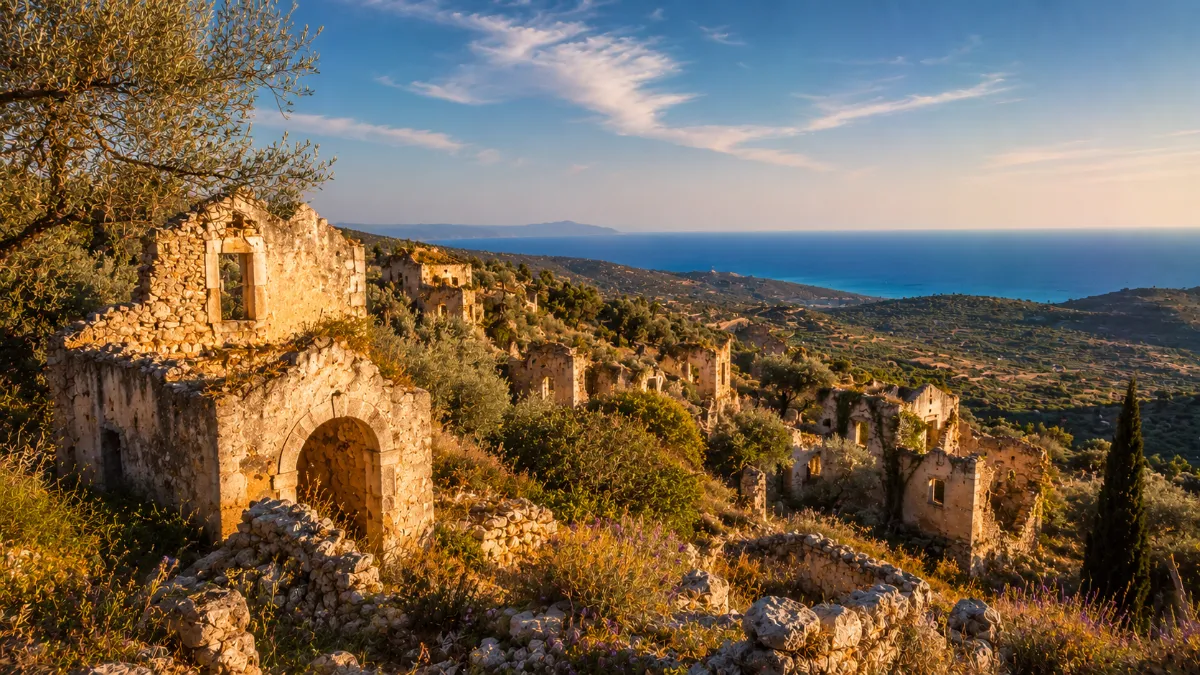
A Village Frozen in August 1953
Palia Valsamata — "Old Valsamata" — is one of several settlements on Kefalonia that were destroyed by the 1953 earthquake and whose survivors chose not to return. The ruins sit on a hillside above the modern village of Valsamata, 15km southeast of Argostoli, in an area also home to the island's most sacred monastery and its most celebrated wine.
The 1953 Earthquake
On 12 August 1953, a sequence of powerful earthquakes — the strongest reaching 7.2 on the Richter scale — struck the southern Ionian Islands. Kefalonia suffered catastrophic damage: 450 people killed, more than 100,000 made homeless, and virtually every stone structure on the island destroyed or rendered uninhabitable. The tremors were followed by fires, which destroyed what the earthquake had left standing. The international relief operation that followed was one of the largest in post-war European history.
The earthquake is the defining event of modern Kefalonian life — it shaped the island's built environment (almost all structures visible today date from the 1950s reconstruction), its demographics (large numbers of Kefalonian families emigrated permanently to Athens, Australia, and North America), and its collective memory.
For the full story of the disaster and its long aftermath, see the 1953 Earthquake in Kefalonia article.
The Ruins
The ruins of Palia Valsamata are not a managed archaeological site or a tourist attraction. They are an overgrown collection of stone walls, arched doorways, collapsed rooflines, and the outlines of yards and streets — the physical record of a community as it stood on the morning of 12 August 1953. Olive trees have grown up through and around the ruins in the decades since. Wild herbs colonise the spaces between the stones.
Access is on foot from Valsamata village — a short, moderately steep walk through the olive groves. There are no facilities, no interpretation panels, and no entrance fee.
In the late afternoon, when the low light crosses the pale stone and the site is largely silent, the ruins have a quality that is difficult to describe precisely. They have not been tidied up or interpreted — they are simply present.
Nearby — A Triangle of Significance
Palia Valsamata sits within a small area of exceptional significance for understanding Kefalonian culture:
Monastery of Agios Gerasimos — 1km from Valsamata. The Monastery of Saint Gerasimos is the most important religious site on the island and the spiritual centre of Kefalonian identity. Gerasimos is the patron saint of Kefalonia, and his feast days (16 August and 20 October) draw pilgrims from across the diaspora. See the Saint Gerasimos article for the full story.
Robola Wine Cooperative — immediately below Valsamata. The home of Kefalonia's PDO Robola white wine, made from the indigenous Robola grape grown in the limestone vineyards of the Omala Valley. The cooperative offers tastings. See the Robola Wine Kefalonia guide for details.
Planning your trip to Kefalonia? Ask Memas — our AI island guide →