If you spend more than a day in Kefalonia, you will encounter Saint Gerasimos everywhere: in the monastery at the foot of Mount Ainos, on the bottles of Robola wine blessed in his name, in the first name of every second man on the island. Children are named after him. The taxi driver who picks you up from the airport may well be called Gerasimos — as may his father, and his grandfather before him.
This is what devotion looks like when it runs four centuries deep.
The Man Behind the Saint
Gerasimos Notaras was born in 1506 in Trikala, Corinthia, in the Peloponnese. He came from one of the most distinguished families in the late Byzantine world. His great-grandfather was Loukas Notaras, the last Megas Doux — Grand Admiral — of the Byzantine Empire, and effectively its last Prime Minister, who served beside Constantine XI Palaiologos during the final days before the fall of Constantinople in 1453. The name Notaras carried the weight of an entire lost civilisation.
Gerasimos was ordained a monk as a young man and spent approximately five years at Mount Athos — the monastic peninsula in northern Greece that remains the heartland of Orthodox monasticism. He acquired there a lifelong nickname: Kapsalis, meaning "the burning one," associated with the settlement of Kapsala on Athos, and perhaps also with the intensity of his ascetic practice.
Twelve Years in Jerusalem
From Mount Athos, Gerasimos travelled south — eventually reaching Jerusalem, where he spent twelve years. The Holy City was then under Ottoman rule, and Greek Orthodox pilgrims visited it at some personal risk. He prayed, studied and deepened his contemplative practice at the sites that are the origin points of Christian faith. After Jerusalem he made his way westward through Crete and then Zakynthos, moving between monastic communities, before arriving in Kefalonia in 1555. He was forty-nine years old.
The Cave in Lassi
His first home in Kefalonia was not a monastery but a cave — a natural cavern in the coastal cliffs near what is now the Lassi peninsula, close to Argostoli. He lived there as a hermit for five years, alone with the sound of the sea and whatever provisions local people left at the cave entrance. The cave has natural daylight — an opening in the rock that admits both light and a view across the water — which may be why Gerasimos chose it over more enclosed alternatives.
The cave can be visited today, and it is one of the quieter, stranger experiences available in the area around Argostoli: a small dark space where a man once spent five years in prayer, with a window of sea and sky at one end.
Word of his presence spread quickly. People came from across the island — and eventually from beyond — to seek his blessing, to bring their sick, to ask for guidance. Kefalonia was then under Venetian rule: a Catholic administration governing a largely Orthodox population. The arrival of a Greek monk with an exceptional spiritual reputation was a significant event.
The Monastery at Omala
In 1560, Gerasimos left the cave. He moved inland to the Omala valley, a fertile plain below the slopes of Mount Ainos, near the village of Valsamata. Here he found a small, abandoned chapel dedicated to the Assumption of the Virgin Mary. He restored it, organised a women's religious community around it, and gradually built what he called "New Jerusalem" — a monastery dedicated to preserving Orthodox faith in the Ionian Islands through the long centuries of Catholic Venetian rule.
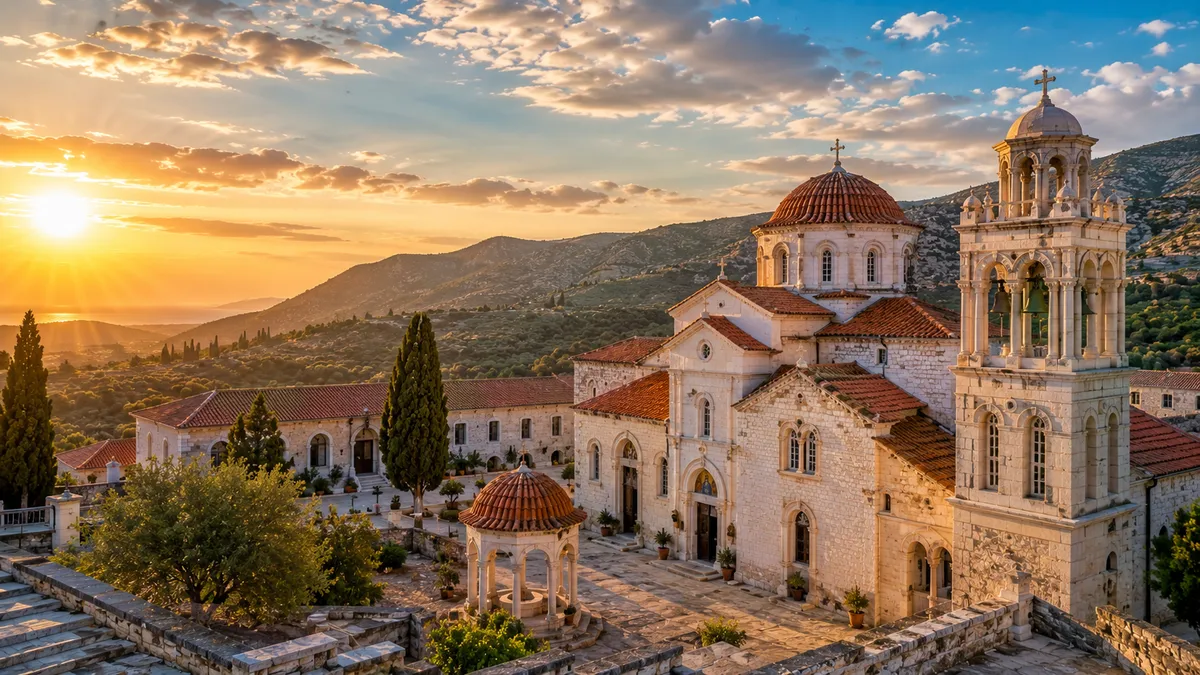
The monastery he established still stands. Three ancient plane trees that Gerasimos planted himself remain in the courtyard — massive, centuries-old presences that shade the flagstones in summer. He dug three wells by hand; those too are still there and still used. The hermitage where he spent his final years is preserved within the complex. And every morning, without interruption since the monastery was established, a liturgy begins at three in the morning and continues until seven — a practice held unbroken for over four and a half centuries.
His most characteristic saying — reportedly the last words he spoke to his community — was simple: "Children, live in peace and do not be arrogant."
The Miracles
Saint Gerasimos was known during his lifetime for two particular gifts: the healing of mental illness and the capacity to drive out evil spirits. In a world without psychiatry or effective treatment for psychosis, these were not small things. Families who had exhausted every other means of helping a suffering relative came to the monastery from across Greece. Many returned home with accounts of sudden recovery. His reputation drew the suffering, the desperate and the faithful in equal measure.
After his death on August 15, 1579, his body was buried in the monastery grounds. When it was exhumed forty days later — as was then the custom — it was found to be entirely incorrupt: neither decomposed nor desiccated, preserved in a manner that the Orthodox tradition regards as the clearest mark of holiness. The Venetian authorities, who governed the island and were not naturally inclined to enthusiasm for Orthodox miracles, ordered a second examination. The result was the same.
He was canonized by the Ecumenical Patriarchate in 1622. His relics — the preserved body — are kept today in a double glass reliquary above his tomb in the monastery's main church, where they are visible to visitors and carried over the sick during feast days.
The miracles did not end with his death. During the catastrophic 1953 earthquake, which destroyed almost every building on the island, multiple witnesses reported seeing a figure in monastic robes moving through the rubble, comforting the injured and the trapped. Those who saw him identified him as Agios Gerasimos. These accounts are part of the living memory of the earthquake generation, told without irony and with complete conviction.
The Feast Days
There are two principal feast days for Saint Gerasimos: August 16, the anniversary of his death, and October 20, which marks the translation of his relics — the ceremonial first moving of his body after it was found incorrupt. Both draw pilgrims from across Kefalonia and from the wider Greek world.
On these days the monastery becomes the centre of the island's life. An all-night liturgy precedes the morning procession. The reliquary is carried out of the church, and the faithful kneel or lie flat on the ground to allow it to be passed over them — a physical act of intercession, seeking the saint's healing power. Pilgrims walk on foot from distant parts of the island; many have made the same journey every year for decades. The monastery also marks August 23, Holy Saturday and Thomas Sunday, but the August and October feast days are the occasions when the full scale of Kefalonian devotion becomes visible.
Memas — The Name That Closes the Distance
Kefalonians have their own name for their patron saint. They call him Memas — a beloved diminutive that, by tradition, is shorthand for the phrase ο Άγιος να είναι μ' εμάς: "may the Saint be with us." The name is used with a warmth and familiarity that captures something essential about Kefalonian faith — less formal than reverence, closer to love.
Gerasimos and Gerasimia are among the most common names on the island. Memas is what you call someone you know well. It is a name that collapses four centuries of distance.
The great twentieth-century spiritual father Saint Paisios of Mount Athos observed that each of the three main Ionian Islands has a patron saint as its spiritual protection: Saint Spyridon on Corfu, Saint Dionysios on Zakynthos, and Saint Gerasimos on Kefalonia. Paisios suggested these saints were placed there as guardians of Orthodox identity in islands that lived for centuries under Catholic Venetian rule — each one a point of spiritual presence at the edge of the western church.
Our AI travel concierge for this website is named Memas in the saint's honour — a small acknowledgment that the monk who made himself available to everyone who needed guidance is as good a model as any for what a concierge should be.
Visiting the Monastery
The Monastery of Agios Gerasimos is located in Valsamata, in the Omala valley — approximately 18 kilometres from Argostoli, in the direction of Mount Ainos. It is open daily:
- Morning: 4:00am to 1:00pm
- Afternoon: 3:30pm to 9:00pm
Visitors are expected to dress modestly: shoulders and knees covered. Wraps are usually available at the entrance. Photography inside the church is generally permitted, though the monastery is an active place of worship and sensitivity is expected.
Inside, the church is dense with icons, candlelight and the smell of incense. The glass reliquary containing Saint Gerasimos' preserved body is the centrepiece of the main nave. Within the monastery complex, the hermitage where Gerasimos spent his final years is preserved and open to visitors. In the courtyard, the three plane trees he planted shade the space where pilgrims have gathered for over four centuries.
For visitor information, contact the monastery directly at (+30) 26710 86385, or see the official visitor information page. The Kefalonia Geopark covers the Omala valley and its landscape in detail, for those interested in the natural setting alongside the spiritual one.
The Saint Who Stayed
Gerasimos Notaras arrived in Kefalonia at forty-nine, carrying the weight of a Byzantine name, twelve years in Jerusalem, and five on Mount Athos. He spent his last twenty-four years on this island — in a cave, then in a valley, tending his community, his plane trees, and his three wells. He died on August 15, 1579, the feast of the Dormition of the Virgin Mary — the same feast his monastery had originally been dedicated to.
For more on the island's layered history, including how Kefalonia got its name and the 1953 earthquake that reshaped the island, explore the blog. And if you want to know more before you arrive — or while you are here — ask Memas.
Planning your trip to Kefalonia? Ask Memas — our AI island guide →