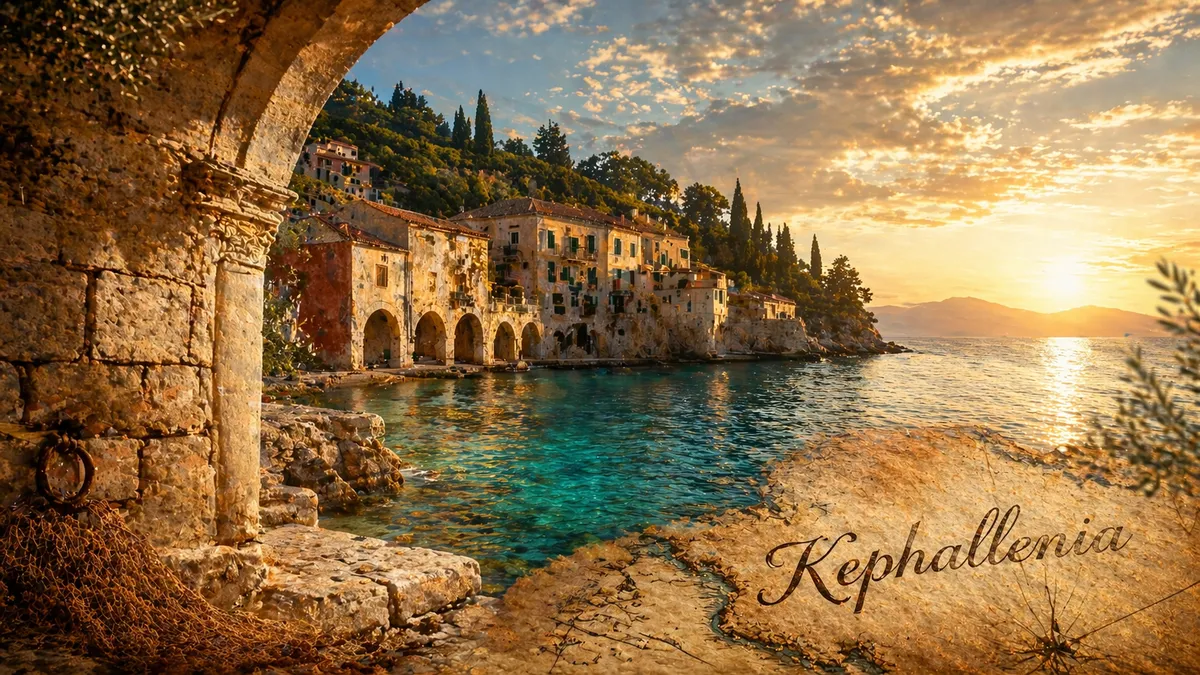
If you've ever searched online for a hotel on this island, you've probably noticed something strange: the place seems to go by at least four different names. Kefalonia. Cephalonia. Kefallinia. Kefalonia. Sometimes even Kefallonya.
This isn't a typo problem. It's millennia of history — myths, conquests, dialects, and spelling debates — compressed into a single word.
Let's untangle it.
The Myth: Cephalus and the Gift of an Island
The most famous version of the island's naming begins with Greek mythology.
According to legend, Kefalonia was named after its first king, the mythical hero Cephalus, who conquered the island in the Bronze Age, together with the Mycenaeans and their leaders Amphitryon and Eleios.
Cephalus was, by the most likely account, an Attic hero — king of the city of Thorikos and founder of the Cephalid clan. After a successful campaign against the Taphians (or Teleboans) who inhabited the area, the island was reportedly gifted to Cephalus in recognition of his decisive role in the victory.
It's a good story. But modern historians have noted something interesting: this version appears to have been, at least in part, a political move by Athens — an attempt to establish a mythological claim to the island and secure future rights over it. Conveniently for this theory, the name "Kephallenia" appears to predate the myth of Cephalus.
The Historical Reality: The Kephallenes Tribe
Behind the myth lies something more concrete: an ancient people.
According to the eminent archaeologist Spyridon Marinatos and historian Mikhail Sakellariou, the island's name most likely derives from the ancient tribe of the Kephallenes — in the Ionic dialect — or Kephallanoi in the Doric. Their name is connected to their mountainous origins, as in ancient Greek, mountain summits were called kephalai — literally, "heads."
In other words: Kefalonia = the island of the mountain-top people. There's something poetically appropriate about this — an island defined by Mount Ainos, its dramatic ridgelines, and the towering cliffs of Myrtos beach carrying that identity right there in its name.
The Four Cities, the Four Names
In classical antiquity, Kefalonia wasn't a unified state. The historian Thucydides calls it a Tetrapolis — four independent city-states: Krani, Palli, Sami, and Pronni. Their names, according to mythology, derive from the four sons of Cephalus.
Each city minted its own coins, governed itself, and occasionally pursued its own foreign policy — Palli sided with the Corinthians in the Peloponnesian War, Krani with the Athenians. What we now call "the island" was, for centuries, four separate small worlds sharing a piece of land.
From Kephallenia to Cephalonia to Kefalonia
During the Byzantine period, the island was part of the Theme of Kephallenia — an administrative district covering several Ionian islands. The form "Kephallenia" (Κεφαλληνία) was the official one.
Under Venetian rule (1500–1797), the island became known to the Western world as Cephalonia — the Latinised version, which is still used in many languages today, including in the title of the novel that put the island on many readers' maps: Captain Corelli's Mandolin.
Everyday use gradually simplified things. "Kephallenia" became "Kefallonia," which became "Kefalonia." The English spelling Kefalonia is a modern phonetic rendering of the Greek — and the one now used officially in international travel contexts.
One L or Two? The Great Debate
In 2011, the Association of Philologists of Kefalonia and Ithaca issued a formal statement recommending the spelling with a single lambda (L) in Greek — arguing that the word derives from the Kephallenes tribe, which itself comes from kephale (head) with the suffix -enes.
The logic is this: if you accept the Cephalus myth, a single L makes etymological sense. If you accept the Kephallenes as the root, the double L has historical grounding.
Officially, Greek public administration still uses the older form Kephallenia (Κεφαλληνία). In everyday speech and tourism, Kefalonia — single L — has clearly won.
How Widespread Is Each Version?
A quick online search today tells the story clearly:
Κεφαλονιά (Kefalonia) ~3,800,000 Κεφαλληνία (Kephallenia) ~1,330,000 Κεφαλλονιά (Kefallonia) ~663,000 Κεφαλωνιά / Κεφαλλωνιά ~7,200The people have voted. Kefalonia — single L, single O — is the dominant form by a factor of nearly three to one.
Why "Kefalonia" Is the Right Choice Internationally
The domain kefalonia.gr didn't choose its spelling at random. It reflects the most widely used international form — the one used by airlines, travel guides, international media, and most tourists who search for the island online.
It also sounds right: Ke-fa-LO-nia. Four syllables, stress on the third. That's exactly how locals say it.
And there's a kind of poetic justice to it: an island that carries the memory of ancient mountain people, Bronze Age conquests, Venetian architecture, Byzantine governance, and devastating earthquakes — all of that history, distilled into one word that the whole world has settled on.
One Name, a Thousand Stories
Few islands carry as many historical layers inside their name as this one. Mythology, ancient tribes, Byzantine administration, Venetian occupation, Greek linguistics and modern tourism — all leave their mark on how we say "Kefalonia."
What's certain is this: whichever spelling you use, the island knows exactly who you're talking about. And it's waiting for you.
Want to explore more of Kefalonia's history and culture? Ask Memas — our AI island guide — anything you'd like to know. Available in English, Greek and Italian.
Planning your trip to Kefalonia? Ask Memas — our AI island guide →