There are places in Kefalonia that don't appear in the brochures. Not because they're not worth visiting — but because they belong, in some deep way, to the people who come from them. Chavdata is one of those places.
Perched at 161 metres above sea level on the southern part of the Paliki peninsula, about 8 kilometres west-southwest of Lixouri, Chavdata is one of the largest and oldest villages in the area — and one of the least visited by outsiders. The road to it passes through olive groves and past the neighbouring villages of Kaminarata and Favatata. It arrives without fanfare: a cluster of stone houses, a church, a square, and a view of the Ionian that stops you mid-sentence.
A Village Built on Deep Roots
Chavdata sits in the Katogi area at 161 metres above sea level and is composed of three formerly separate neighbourhoods — Ernikata, Katerelata and Tipaldata — each of which was once its own distinct settlement before they merged into one community. The name itself carries history: scholars give two possible explanations for its origin — either from the Byzantine word chafdotis, meaning one who has a profession (particularly a latinieris or stagkotis), or from a corruption of the word ampito, a type of thick winter garment.
Either origin points to the same truth: this is a place with deep Byzantine roots, shaped by centuries of Venetian rule and Ionian resilience. Like every village on Paliki, Chavdata has known conquerors and liberators, earthquakes and rebuilding. What it has never lost is its identity.
The village is home to many families who share the surname Mourelatos — a name so common here that, over generations, families began using nicknames to tell each other apart. One branch of the Mourelatos family has long been known by the nickname Morletas. Their roots here run as deep as the olive trees on the hillsides.
The Church of the Holy Apostles
In the church of the Holy Apostles in Chavdata there is a carved wooden icon-screen and post-Byzantine icons — among the finest examples of religious woodcarving in the Paliki region. The church is the spiritual anchor of the village and the site of its great annual festival, organized by the cultural association "The Twelve Apostles", which typically takes place in August and draws former villagers and their descendants back from across Greece and the diaspora.
The Chapel of Agios Nektarios
Of all the small sacred spaces in and around Chavdata, few carry as much quiet significance as the chapel of Agios Nektarios — Saint Nektarios of Aegina, the beloved modern saint of the Greek Orthodox Church, known throughout Greece as a healer and intercessor.
The chapel was built through the devotion and effort of two local families who lived nearby — one of them the Mourelatos family, known locally as the Morletas. It stands as a testament to the way faith has always worked in these small Kefalonian communities: not through grand institutions but through the hands of ordinary families who built what they believed was needed and what they wanted to last.
Saint Nektarios, who died in 1920 and was canonised in 1961, is one of the most widely venerated saints of the modern Orthodox world. That a chapel dedicated to him exists in a small Paliki village — built by local families — speaks to the living continuity of faith in a place where the old and the new are never far apart.
The chapel is small, as such chapels always are. But small is the right size for something built with that kind of intention.
Sightseeing Around Chavdata
The Monastery of Kipouria is one of the most dramatic sights in all of Kefalonia — and Chavdata is among the closest villages to it. Founded in 1759, the monastery is famous for its lush gardens, beautiful views of Kefalonia's incredible sunsets and how it's perched on the edge of a dramatic white cliff. The drive from Chavdata to Kipouria passes through some of the most unspoiled scenery on the island.
The Chapel of Agios Ilias celebrates its feast day on July 19th — a traditional Kefalonian panegyri with music, food and the particular warmth of a community gathering around something it has always done.
The Monastery of the Holy Apostle Koronatos, with its nuns' retreat, lies about two kilometres east of Chavdata, set in delightful surroundings.
The road south from Chavdata leads through the western spine of the Paliki peninsula — as remote and beautiful a drive as you'll find on the island — past the old monastery of Saint Paraskevi Tafion and eventually to Kipouria itself.
Nearby Beaches
Paliki's beaches are among the most distinctive in Kefalonia, and Chavdata sits within easy reach of several of them.
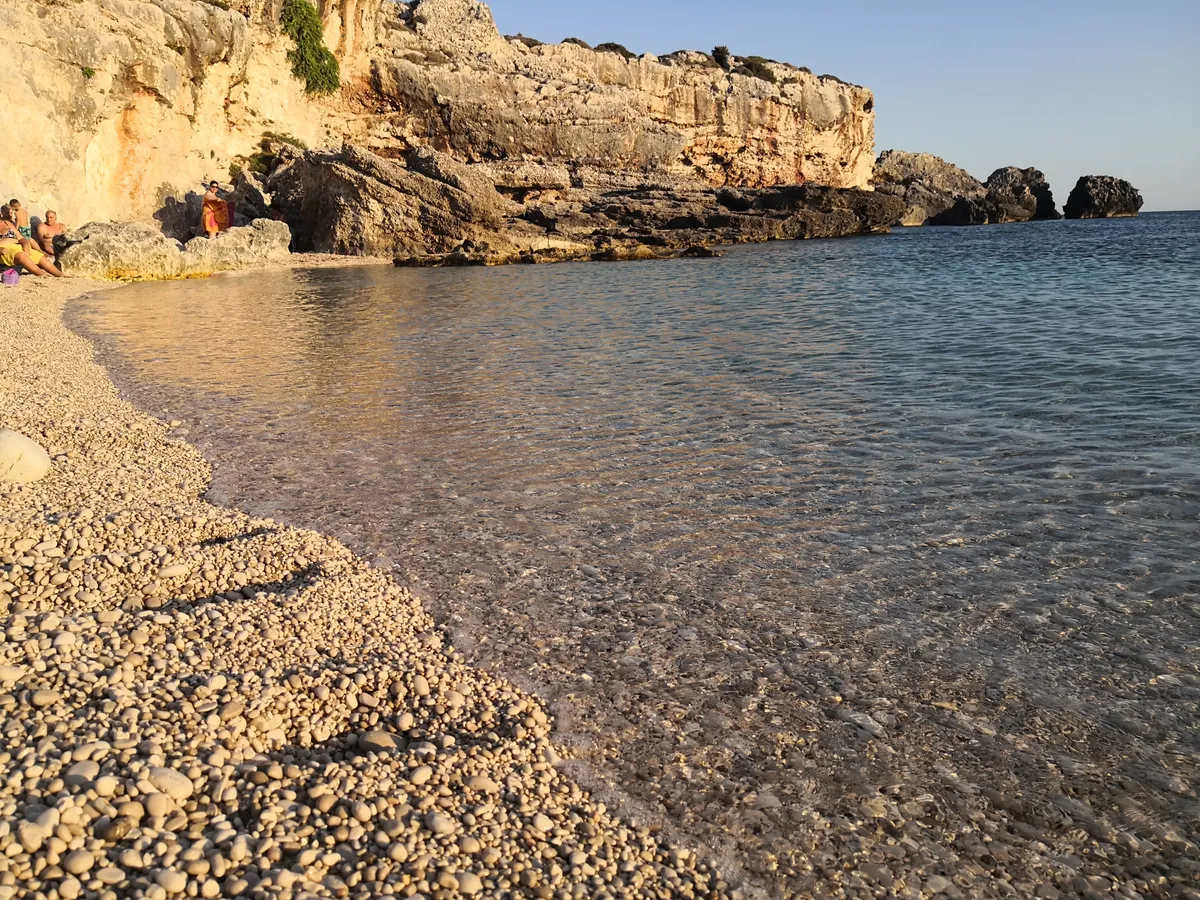
Lagkadakia — the beach that generations of Chavdata families have called their own. Tucked into a small protected cove between the villages of Chavdata and Havriata, Lagkadakia is not a beach you stumble upon. You have to know it's there. White pebbles, blue-green water of an extraordinary clarity, and a seabed of caves and rock formations that make it a favourite among snorkellers and divers. According to local tradition, this is the site where Odysseus's Palace once stood — a claim that remains unverified but speaks to how ancient this stretch of coastline feels. No facilities, no crowds. Just the sea and the sound of it, the way it has always been for the families of this village.
Petanoi Beach — arguably the finest beach on the Paliki peninsula — is accessible from the western road that passes near Chavdata. Turquoise water, white pebbles, imposing cliffs rising on both sides: Petanoi is Myrtos's quieter sibling, without the crowds. A taverna at the top of the descent serves fresh fish and cold Robola.
Xi Beach, with its famous red-orange clay cliffs and shallow, warm water, is to the south. The clay that colours the shore and the cliffs is the same clay that makes Paliki's soil so fertile — the same land that sustained the families of these villages for centuries.
Mega Lakkos — a small, less-visited bay with a Venetian name meaning "the great hollow" — lies between Xi and Petani, accessible by a smaller road. Clear water, almost no facilities, and the particular peace of a beach that most people drive past.
How to Get to Chavdata
From Lixouri, take the road northwest out of town and follow signs for Kaminarata and Favatata. Chavdata is the next village. The drive takes about 15-20 minutes through countryside that feels genuinely removed from the tourist trail.
The village is best visited as part of a longer loop: Lixouri → Chavdata → Kipouria Monastery → Petanoi Beach → back via Xi Beach → Lixouri ferry back to Argostoli. Allow a full day.
A Note
Some places exist in the itineraries. Others exist in the memory — the kind passed down at tables, in the telling of names and nicknames, in the knowledge of which family built which chapel. Chavdata is the second kind of place.
It rewards the traveller who arrives curious and leaves slowly.
Want to know how to plan a day around Paliki's villages and beaches? Ask Memas — our AI island guide knows the roads, the routes and the right time of day for each.
Part of our complete guide: Kefalonia Villages
Continue exploring:
Planning your trip to Kefalonia? Ask Memas — our AI island guide →