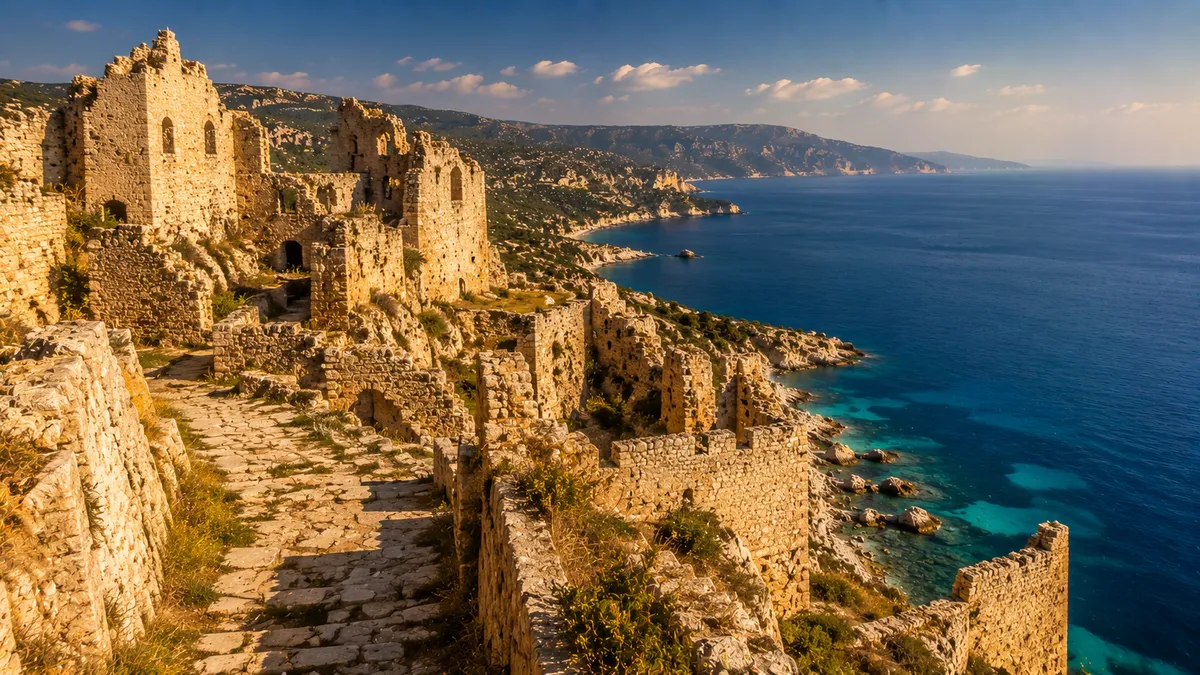
Two Castles, Five Centuries of History
Kefalonia has two great castles — the Castle of Saint George (Agios Georgios, locally called Kastro) near Peratata, and the Venetian Castle of Assos on the northwest coast. Together they span five centuries of Frankish, Venetian, and later occupation, and both are worth visiting for their history, their ruins, and their extraordinary views.
The island's name itself reflects this layered history. For the full story of where "Kefalonia" comes from, see the History of the Name Kefalonia article.
Castle of Saint George (Kastro)
The Castle of Saint George stands on a 320m hilltop above the village of Peratata, 9km southeast of Argostoli. It was the administrative capital of Kefalonia for over 400 years — from the 12th century under the Frankish Orsini family, through the long Venetian period, until 1757, when the Venetians transferred the seat of government to what is now Argostoli.
The ruins cover a substantial area enclosed by defensive walls up to 4m thick. Walking the perimeter takes about 45 minutes. What survives includes stretches of curtain wall, the remains of three churches, underground cisterns that supplied the population during sieges, and the barrel-vaulted passages between the inner bastions.
The views from the ramparts are exceptional in every direction: west across the Argostoli Gulf and the Lixouri peninsula, south toward Zakynthos, and north toward the mountains of the island's interior. On clear days, the Peloponnese coastline is visible.
Practical:
- Location: Peratata village, 9km from Argostoli
- Entry: €3
- Hours (summer): 8:00–20:00
- Allow 1.5–2 hours including the walk
Castle of Assos
The Venetian Castle of Assos crowns the narrow peninsula above the village of Assos on the northwest coast, 45km from Argostoli. It was built by the Venetians in 1593 to defend the northern approaches to Kefalonia during a period of intense Ottoman naval activity in the Ionian.
The castle is one of the largest Venetian fortifications in the Mediterranean, enclosing the entire 12-hectare peninsula within its walls. The walls are remarkably well-preserved — in places, the original Venetian stonework stands to full height. Inside the enclosure: ruined administrative buildings, a church dedicated to Saint Mark, an underground cistern, and the slowly returning vegetation of a site left largely to itself.
The views from Assos Castle are exceptional. Looking down: the village of Assos, its pastel-coloured houses arranged around a horseshoe harbour. Looking north: open sea and, on clear days, the outline of Lefkada. Looking south: the mountain spine of Kefalonia disappearing into distance.
Practical:
- Location: Assos village, 45km from Argostoli
- Entry: free
- No road access — walk from village (20 minutes, steep path)
- Go in early morning before the heat builds
Planning your trip to Kefalonia? Ask Memas — our AI island guide →