Kefalonia on Screen
Released in 2001 and starring Nicolas Cage as the Italian officer Antonio Corelli and Penélope Cruz as the Greek islander Pelagia, Captain Corelli's Mandolin brought Kefalonia to international attention in a way no travel brochure had managed before. The film is based on Louis de Bernières' 1994 novel set during the Italian and German occupation of Kefalonia in the Second World War — a period that ended in the Acqui Division massacre of 1943, one of the worst atrocities against Italian troops by the Germans.
Much of the film's interior shooting took place at Pinewood Studios in England, but the outdoor Greek sequences were filmed almost entirely on location in Kefalonia, and those locations remain among the island's most visited and most photographed spots.
Antisamos Beach
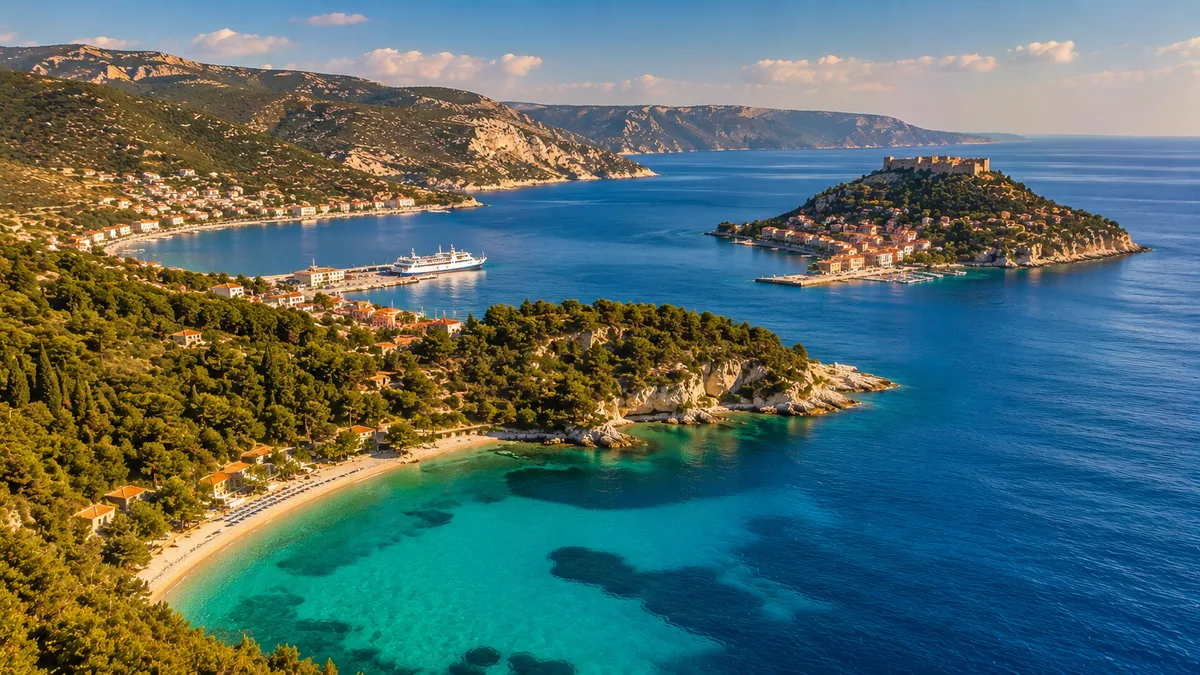
The most recognisable setting from the film is Antisamos beach, on the east coast near Sami. Its distinctive oval bay, dramatic limestone cliffs and intensely turquoise water formed the backdrop for several of the film's key scenes, including sequences involving the beach and the Italian soldiers. Antisamos is accessible by a steep road off the Sami–Argostoli highway; there is a small car park at the top. The beach remains one of the most beautiful on the island, and visitors who have seen the film will recognise it immediately.
Sami
The town of Sami stood in for the island's main port town in the film. Several harbour scenes were shot here, and the town provided the texture of a working Greek island community in the 1940s. Sami today is the island's main ferry port and a practical base for exploring the northeast of the island.
Assos
The preserved village of Assos — one of the most beautiful in Greece — appears in some of the more romantic and village-community sequences. Assos survived the 1953 earthquake relatively well, and its Venetian stone houses, narrow lanes and the hill above crowned by the great Assos Castle give it an authenticity that transfers well to screen. The three villages guide at Fiskardo, Assos & Argostoli has more on visiting Assos.
Argostoli
Sections of the film set in the island's main town were shot in Argostoli. The town was almost entirely destroyed in the 1953 earthquake and rebuilt in a more practical modern style, so the pre-war architecture depicted in the film is a cinematic reconstruction — but the waterfront, the lagoon bridge, and the general atmosphere of a substantial island capital remain.
The History Behind the Story
The novel and film draw on one of the island's most tragic episodes: the Kefalonia Massacre of September 1943, when German forces killed approximately 5,000 Italian soldiers of the Acqui Division after Italy signed the armistice with the Allies. The Italians refused to surrender their weapons and resisted for several days before being overwhelmed. The massacre is commemorated on the island, and the weight of this history gives the story its emotional power.
Visiting the Locations Today
- Antisamos: 20 minutes from Argostoli; accessible by car; Blue Flag beach with facilities in season
- Sami: 40 minutes from Argostoli; active port town; ferry connections to mainland and Ithaca
- Assos: 45 minutes from Argostoli via a spectacular coastal road; village and castle both worth exploring
Planning your trip to Kefalonia? Ask Memas — our AI island guide →