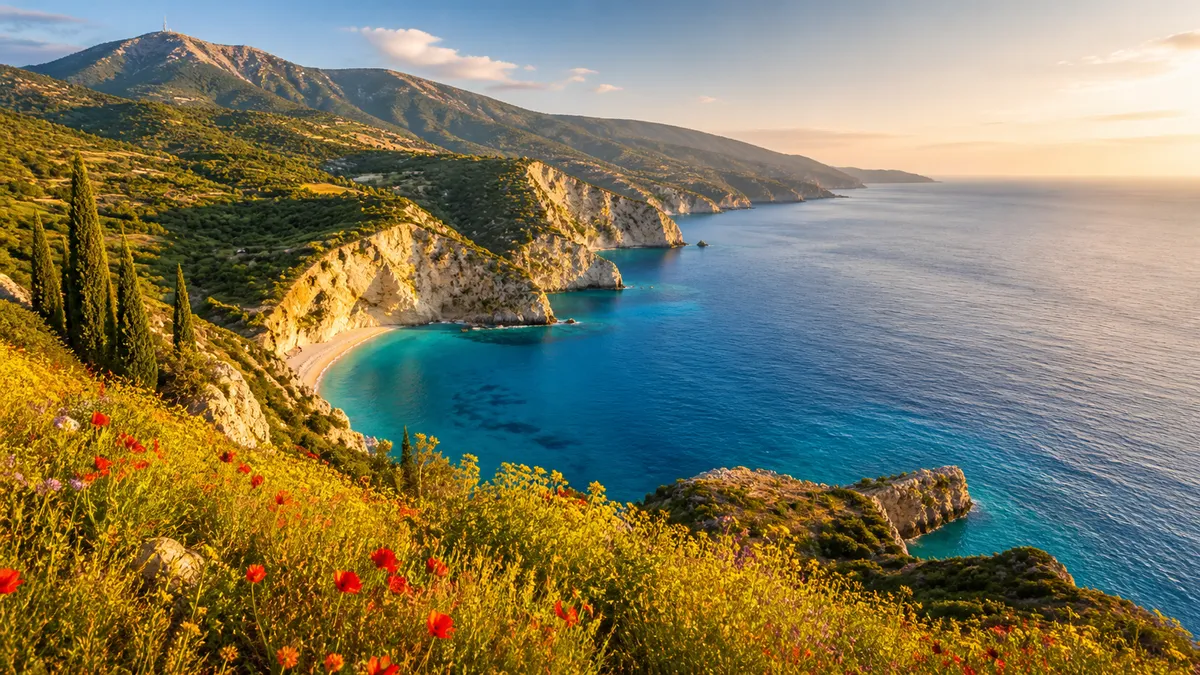
There's a version of Kefalonia that most visitors never see. It arrives in May, stays for about six weeks, and then quietly gives way to the crowds of July and August. The locals know it well. The repeat visitors know it. And now, if you're reading this in time, you can know it too.
May in Kefalonia is the island at its most itself: warm enough for the beach, cool enough for long drives through the mountains, wildflowers still covering the slopes of Mount Ainos, and a pace of life that hasn't yet shifted into full tourist-season gear.
The Weather: What to Expect
May sits in the sweet spot of Kefalonia's calendar — warm, sunny and ideal for outdoor activities. Daytime temperatures hover between 20°C and 26°C, with light breezes off the Ionian making even the warmest afternoons comfortable. The sea is still waking up — water temperatures are around 19–21°C, cool enough to feel refreshing, warm enough to stay in for an hour.
Rain is possible but rare, usually confined to brief morning showers that clear by midday. The landscape still carries the lush green of winter — the hills are deeply forested, the valleys vivid with wildflowers, and the drive from Argostoli to Myrtos through winding mountain roads is at its most beautiful.
The Beaches: Yours, Nearly
This is the central truth of a May visit: the beaches are open, beautiful and uncrowded.
Myrtos — the most photographed beach in the Ionian, with its white pebbles and towering limestone cliffs — is accessible and serene. You'll find a handful of sun loungers available, the water a deep turquoise-blue, and none of the July chaos. Viewed from above, Myrtos presents limestone cliffs, pine trees, a luxurious stretch of pebbles and a blanket of Ionian blue — wild beauty on a grand scale.
Antisamos — the beach made famous by Captain Corelli's Mandolin — is at its greenest, backed by hills dense with pines. Arrive early and you may have it to yourself.
Fteri Beach — reachable only on foot, after a hike that earns every metre — is the island's most secret reward. No road, no facilities, no crowds. Just an extraordinary blue-green cove of white pebbles and water that genuinely looks impossible. More on this below.
Skala — a long sandy beach in the south with a relaxed taverna scene — opens fully in May and is an excellent base for families.
Xi Beach on the Paliki peninsula, with its distinctive red clay cliffs and shallow warm water, is another good May option. The parasols are out but the beach is never packed.
Fteri Beach: The Reward at the End of the Hard Way
If there's one May experience that separates the adventurous from the sensible, it's the hike to Fteri Beach. There's no road. There's no car park. There's no easy way in. What there is: a trail through terrain that one recent visitor described as "Hell's Canyon and Treachery Falls" — steep, rocky, occasionally requiring creative use of one's posterior on the descent — flanked by wildflowers in colours so vivid they look like an MGM film set.
At the bottom: a beach with water so intensely blue it resembles a cooking pot of aquamarine glacier mints. White pebbles, no sunbeds, no taverna, no crowds. Just you, the Ionian, and the quiet satisfaction of having earned it.
May is the ideal month to attempt it. The wildflowers are in bloom, the temperature is manageable, and the overcast mornings that sometimes start a May day in Kefalonia make the hike genuinely pleasant. Would it be recommended on a 35°C August afternoon? Absolutely not. In May? Absolutely yes — though perhaps bring iron lungs and pack your pride separately.
Mount Ainos: Hiking Season Begins
Spring is ideal for outdoor activities like hiking on Mount Ainos, and May is arguably the best month. The peak reaches 1,600m and is home to a Natura 2000-protected national park — dense forests of Kefalonian fir, wild horses that roam the upper slopes, and panoramic views stretching from Ithaca in the north to Zakynthos in the south on a clear day.
The main trail from the Ainos plateau is well-marked and takes about 2 hours return to the summit. Go early to catch the light before the clouds build at midday.
The Caves: No Queues
Melissani Cave — the underground lake where sunlight pours through a collapsed ceiling and turns the water a supernatural shade of blue — is one of the most remarkable sights in Greece. In July, the queue for the boat can be 45 minutes. In May, you walk straight in. The effect of the midday light on the water is at its peak in late May when the sun is high enough to hit the lake directly.
Drogarati Cave, nearby, is believed to be 150 million years old. Its extraordinary acoustics made it famous — concerts have been held inside. In spring, the cave stays cool (around 14°C), making it a welcome stop on a warm afternoon.
Villages: Fiskardo, Assos & Lixouri
Fiskardo, the island's most photogenic harbour, is best experienced before high season. The Venetian buildings, the yachts, the waterfront restaurants — all of it is there in May, without the July prices and the waitlists.
Assos, a small village wrapped around the peninsula beneath its Venetian castle, is one of those places that takes your breath away the first time. In May the drive down to it is flanked by wildflowers, and the village itself moves at its own quiet rhythm.
Lixouri — the island's second town, across the bay from Argostoli — is at its most local in May. The morning market, the square, the tavernas that serve what was caught or raised that week. The ferry across from Argostoli takes 15 minutes and runs every half hour.
Sea Turtles at Koutavos
The loggerhead sea turtles begin gathering in Argostoli Bay from early spring. By May they're reliably present around the harbour and along the Koutavos Lagoon. Walk the De Bosset Bridge (the Pontes) in the morning and keep your eyes on the water — they surface every few minutes to breathe.
Wine: Robola Country
The Robola grape doesn't grow with the same character anywhere else in the world, and May is a lovely time to visit the Robola Cooperative in the Omala Valley. Tastings are relaxed, the vineyards are lush, and you'll understand why this mineral, citrusy white wine pairs so perfectly with Kefalonian seafood.
Practical Notes for May
Restaurants and businesses: Most are open from May 1st. A few niche spots in touristy areas open later — if in doubt, call ahead.
Crowds: Minimal compared to July-August. You'll share beaches with Greek families, a growing number of European visitors, and the occasional early-bird traveller who knows the secret.
Booking: Car rental is essential and should be booked in advance — desks get busy even in shoulder season. Hotels offer their best rates in May.
Driving: The roads are dry, clear and at their most rewarding for scenic drives.
Want to know what's specifically on this week in Kefalonia, or plan an itinerary around what you love? Ask Memas — our AI island guide is here to help.
Planning your trip to Kefalonia? Ask Memas — our AI island guide →