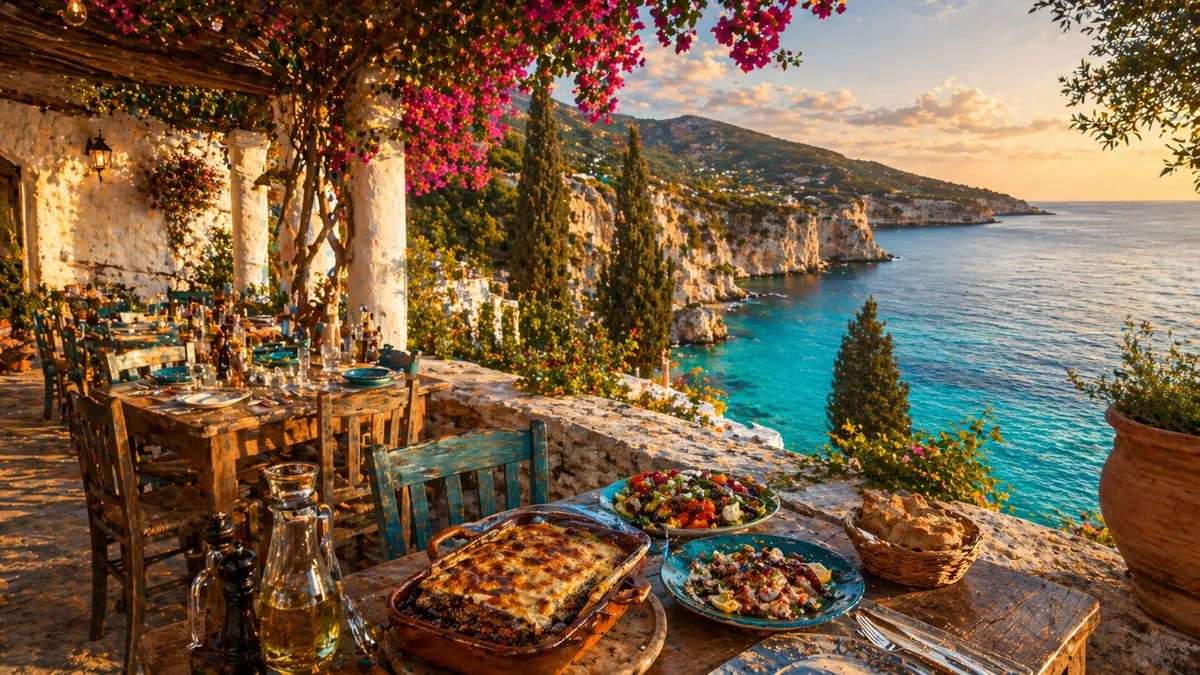
There's a moment that happens to most visitors in Kefalonia, usually on the second or third evening. You sit down at a table with a view of the water, a carafe of cold Robola arrives without you asking for it, and something slow-cooked lands in front of you — and you realise that eating well here requires almost no effort at all.
Kefalonian food is not Greek food in the generic sense. It's a cuisine shaped by centuries of Venetian occupation, by mountain villages that had to be self-sufficient, by fishermen who knew which spice made the difference. The result is a table that feels simultaneously familiar and deeply local.
The Dishes You Need to Try
Start with kreatopita — the island's signature meat pie, filled with spiced minced meat and encased in a thick, slightly crumbly pastry. Every village has its version; every family insists theirs is the original. A family-run taverna with stone walls is the right setting to try it — order it as a starter and share.
Bourdeto is the dish that divides opinion in the best possible way: a spicy fish stew, built on red pepper and garlic, that hits harder than anything else on a Greek menu. Scorpion fish is traditional, but sea bream or cod works too. Don't order it if you don't like heat. Order it if you do.
For meat, sofigado — slow-braised goat with spices and a dark, wine-rich sauce — is what Kefalonian mountain cooking looks like at its best. Lagoto, rabbit braised long and low in white wine with rosemary and bay, is its gentler sibling. These rural stews are particularly rewarding and rarely appear on tourist menus, which is exactly how to identify the right taverna: if the menu has photos of pizza, walk past.
For something lighter, riganada — stale bread soaked in olive oil and tomato, topped with local cheese and dried oregano — is the kind of thing you eat standing up at a market stall and then find yourself thinking about for days. Finish with mandoles: caramelised almonds coated in sugar, sold in paper cones at every festival and increasingly in proper cafés.
And throughout all of it: Robola. A mineral, crisp wine made from an indigenous grape that grows nowhere else with the same character — it pairs with fish, with cheese, with the heat of bourdeto, with nothing at all on a warm evening. If you're interested, the Robola Cooperative in the Omala Valley does tastings with views of the vineyards.
Where to Eat, Area by Area
Argostoli is the capital and, to the surprise of many first-timers, has a genuinely good food scene. Patsouras, near the fish market, has been serving traditional dishes since 1963 in an authentic, no-frills avatar — there's no menu, staff show you what's available and take your order accordingly. It's the kind of place that ruins you for everywhere else. The waterfront has plenty of options too, from harbour-side tables where you eat fish that was swimming that morning, to the marble-paved Lithostroto street for coffee and pastries.
Fiskardo plays a different game entirely. The only settlement that survived the devastating 1953 earthquake, it wears its Venetian heritage openly: pastel buildings, a harbour lined with yachts, and restaurants that have learned to match the setting. Tassia, the harbour's oldest restaurant, has been serving traditional Greek recipes since 1972. It's also where a celebrity clientele has occasionally been spotted — but the food would justify the visit regardless. Reserve in July and August; harbour-front tables go fast.
Lixouri, across the bay from Argostoli (connected by a small ferry that runs every half hour), is where the food is the most local and the least performed. The main square has tavernas where the menu changes with what's been caught or slaughtered that week, and prices are noticeably lower than anywhere tourists concentrate. If you want to eat the way Kefalonians actually eat, come here.
Sami and Agia Efimia on the east coast offer the most relaxed dining on the island — waterfront tables, simple fish preparations, and the kind of service that lets you sit for three hours without anyone suggesting you might like to leave. Erasmia in Agia Efimia is a harbour-front spot with honest fish and east-coast charm.
A Few Practical Things
The Greek lunch happens between 2 and 3pm; dinner starts properly at 9 or 10. Showing up at 7pm is possible, but you'll be eating alone and the kitchen won't be at full speed. When in doubt, always ask what's fresh today — in a good taverna, the answer will change the order. And the presence of a menu with laminated photos is, almost without exception, a sign to keep walking.
Not sure where to eat tonight? Ask Memas — our AI island concierge knows every corner of Kefalonia and can suggest the right restaurant based on where you're staying, what you're in the mood for, and what's actually worth the drive.
Planning your trip to Kefalonia? Ask Memas — our AI island guide →